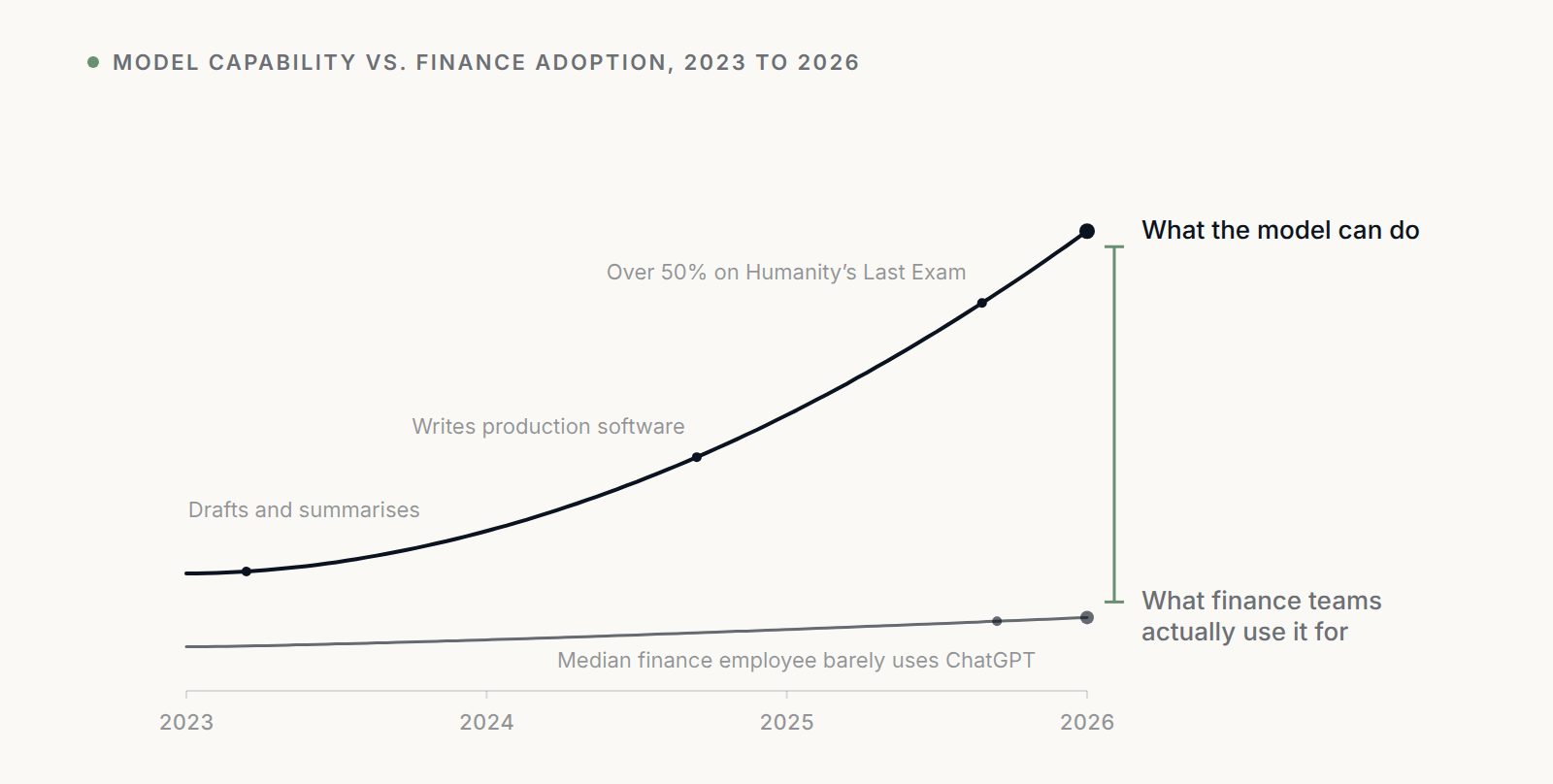
We live in extraordinary times. AI is solving previously unsolved maths problems, and Fable 5 scores over 50% on Humanity's Last Exam. We hear of Claude Code 10x-ing software engineers and cutting customer support costs 5x. AI clearly has the intellectual capability to do the vast majority of finance tasks. So everyone in strategic finance is being pestered about AI: every board asks its finance team about adoption, and every CFO wants automations that free the team up for the truly strategic work.
At the same time, actual adoption in strategic finance is underwhelming. The median employee barely uses ChatGPT, and only the best companies have a handful of super users. Most of the work is still manual and lives in spreadsheets. I want to unpack the biggest blockers.
A quick note on why I am the one talking about this: through my startup margin , I have spent over three years obsessing over building AI tooling for strategic finance. We work with the top 0.1% most AI-native finance people at leading financial services, tech, and industrials businesses.
Every time you start a new chat, you are onboarding a brilliant new employee.
First, a framing that makes the blockers easier to see. Every time you open a fresh Claude or ChatGPT session, you are onboarding a brilliant new employee. You cannot assume a new hire knows the specifics of your business. They do not know exactly how you define revenue, how you run variance analysis, or what numbers your CFO likes to see. The same goes for an AI agent: every instruction needs to carry all the information the task requires. Leave something out, and you force it to guess.
AI is smart, so the guesses are usually good, but force enough of them, and it will eventually fail. So the main blocker to automating knowledge work is getting the AI the data it needs for the task. This is called context management, and it is the crux of every AI implementation today.
How most finance people use AI today
The one-off solution to context management is manual: collect the data yourself and hand the agent full context for the task. Take variance analysis. You want to see how the business performed against the budget you planned, so you export the budget, the actuals and a previous variance analysis, and feed it all into Claude with a detailed prompt.
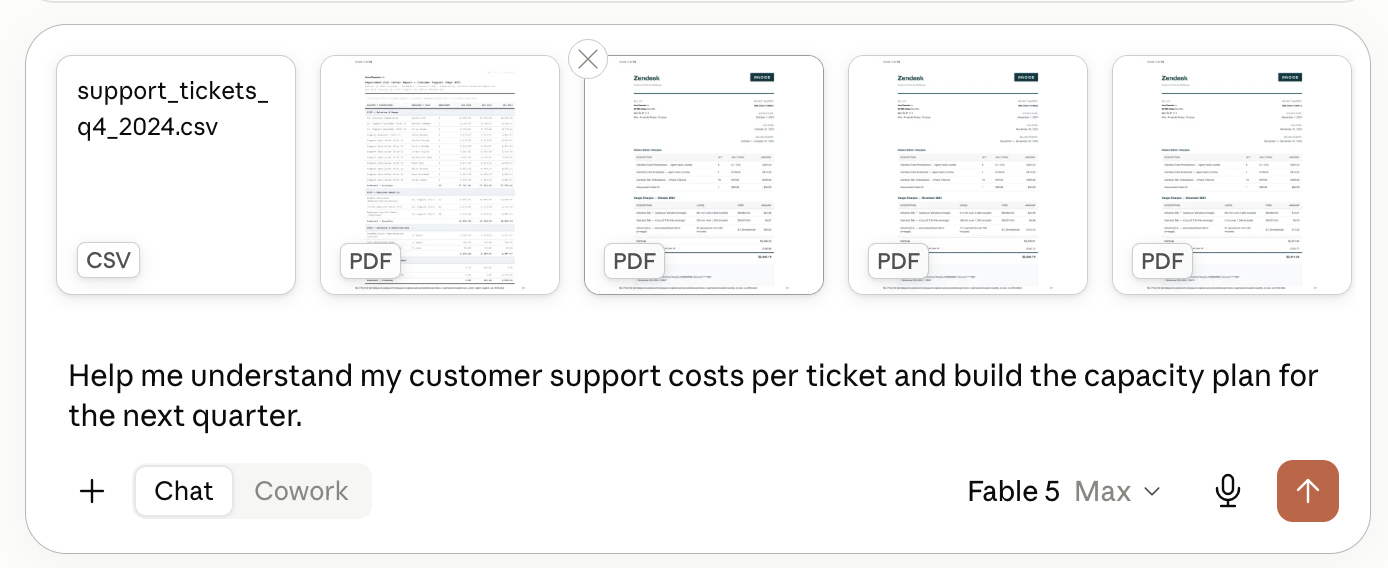
This is a good first step, but it breaks quickly, on three fronts:
- You almost certainly did not provide full context. It is very hard to think of everything about your business that is obvious to you and invisible to the AI.
- Collecting the data and writing the context takes serious time. Past a point, gathering everything takes longer than doing the task yourself.
- Next month, when variance analysis comes around again, you repeat the whole process.
Blocker one: AI agents for strategic finance need great memory
The fix for all the breaking points above is giving your agents great memory.
Strategic finance work is deeply specific to the business. Agents need to know how your metrics are defined, which cost lines can be cut and which cannot, and how you like analysis done. Manually briefing every new agent you spin up is not realistic.
The first-generation answer is skills and md files: a knowledge base for your army of agents. It is very hard to execute well. Context goes stale while the number of files explodes, and after a couple of months you are either auditing everything your agents have written or feeding them outdated and incorrect information.
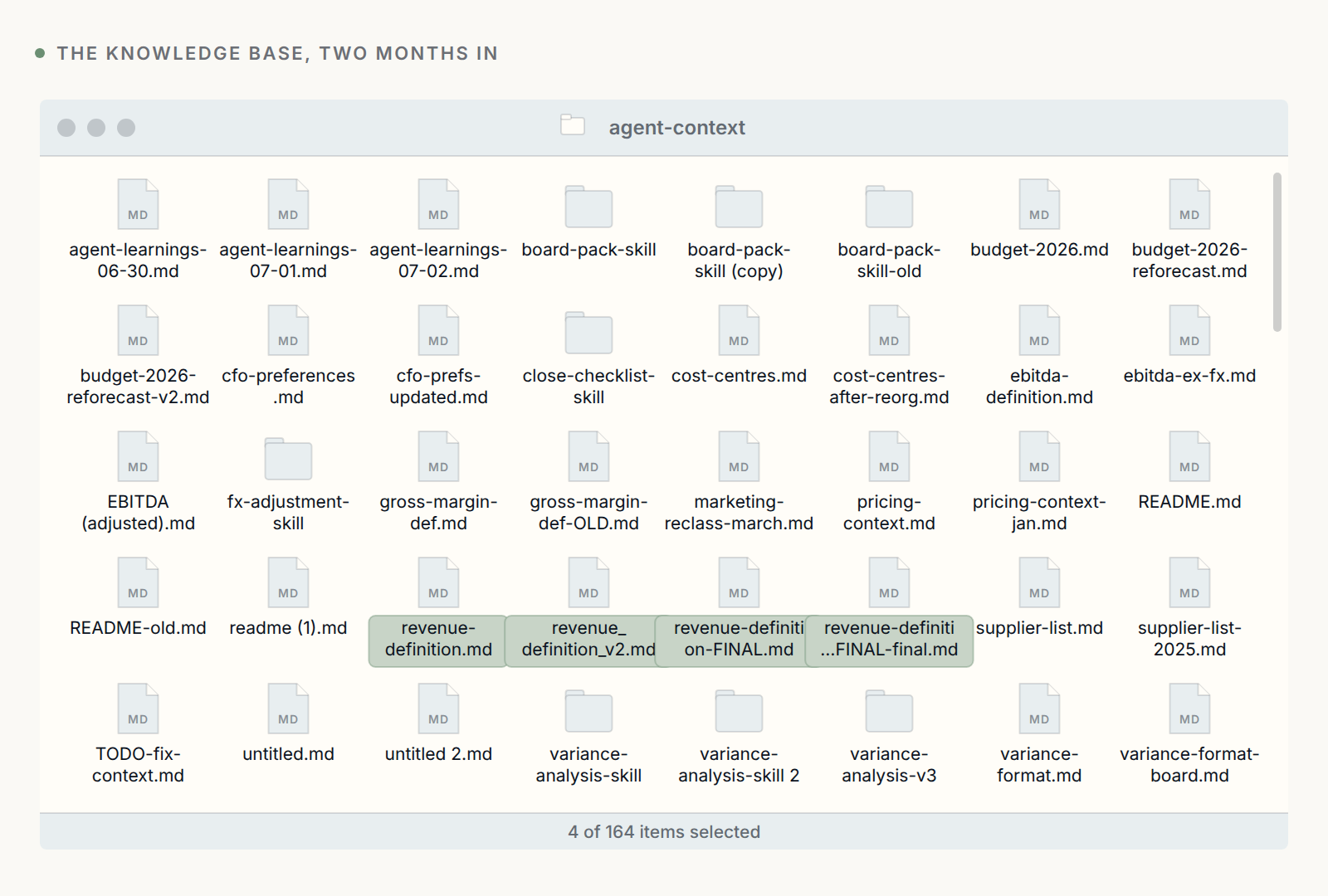
For the vast majority of enterprises, building a good in-house memory system for finance work is unrealistic. So finance people are stuck using AI as a co-worker they have to onboard anew to every single task.
Blocker two: real enterprise data is extremely messy
The other half of context management is access to company data. And as everyone knows, enterprise data is almost always a mess. As a rule, if a finance person cannot do a task because the data does not exist or is too messy, an AI agent cannot do it either. Thus, to consider what an AI needs to perform a task, we just need to think about what a data-driven decision needs in general. In the context of strategic finance, the data must be:
- Correct
- Available at the Time of the analysis
- Available at the correct Grain
Correctness and timeliness are self-explanatory, and neither is a given in enterprise. Finance functions were built to report on the past, so getting correct data at the moment a decision is made, rather than months after, is often incredibly hard.
Grain matters just as much. Pricing a customer, you want customer-level data, not the average behaviour across the whole company. The same holds for almost every strategic finance decision: challenging a supplier needs supplier grain, and judging whether a transaction makes money needs transaction grain.
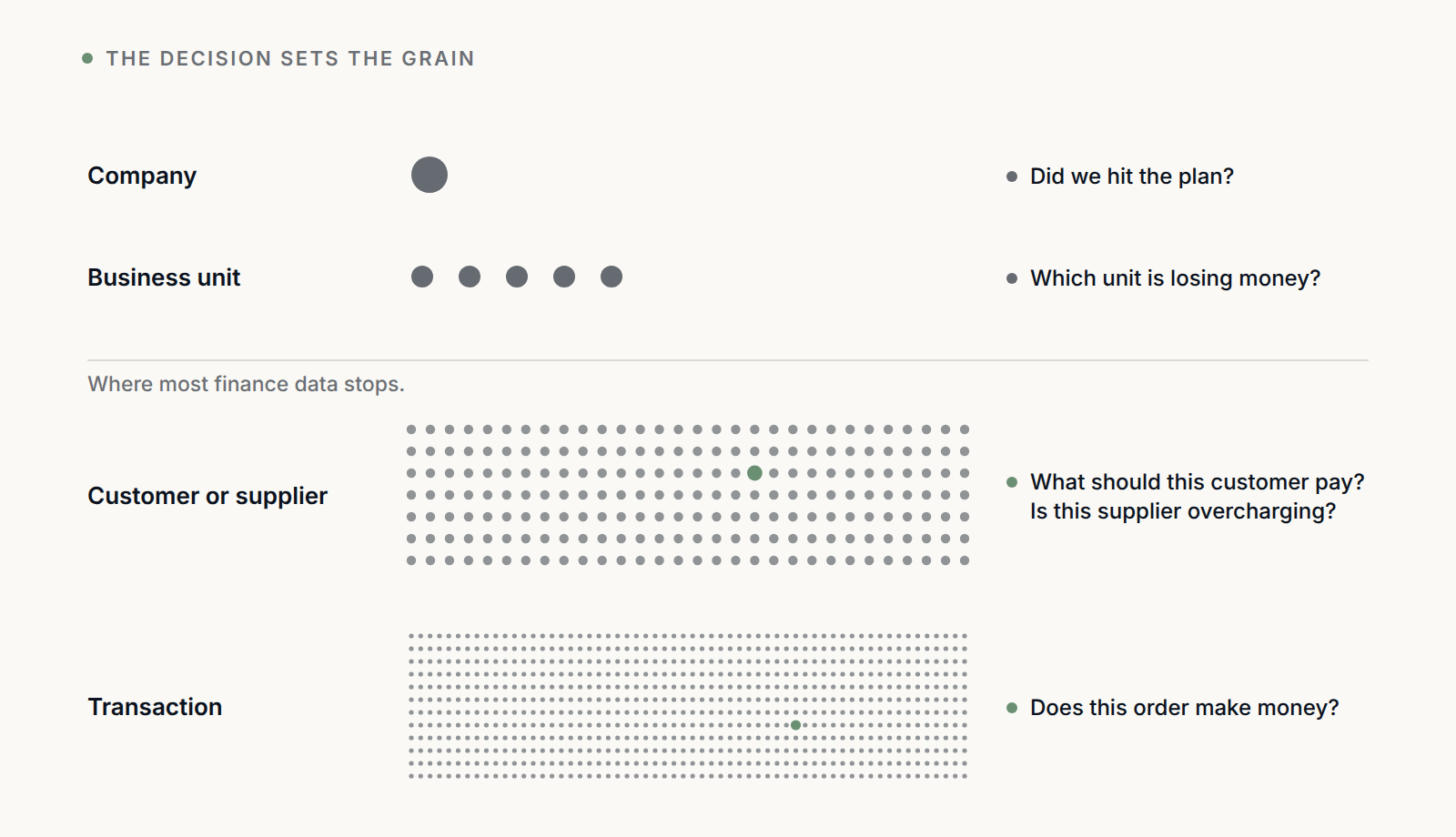
The vast majority of enterprises have data that is none of the three. As a result, a lot of extremely valuable strategic finance work is currently out of reach even for humans. Unlocking it often means data cleanups, which are expensive and slow. Fortunately, AI can help there too, though that is content for another post.
Blocker three: trust has no way to be earned while the work is incredibly high stakes
On the biggest strategic finance decisions: pricing, product, and resource allocation, you simply cannot be wrong. Every data point has to reconcile to the GL, and every model has to be defensible in front of your CFO, your board, or sometimes an auditor. The correctness bar is simply higher than for other types of work.
Worse, finance has no universal correctness check. Code either compiles and works or it does not, so slop is easy to spot. Finance runs on judgement, so excellence and slop can look identical at first glance.
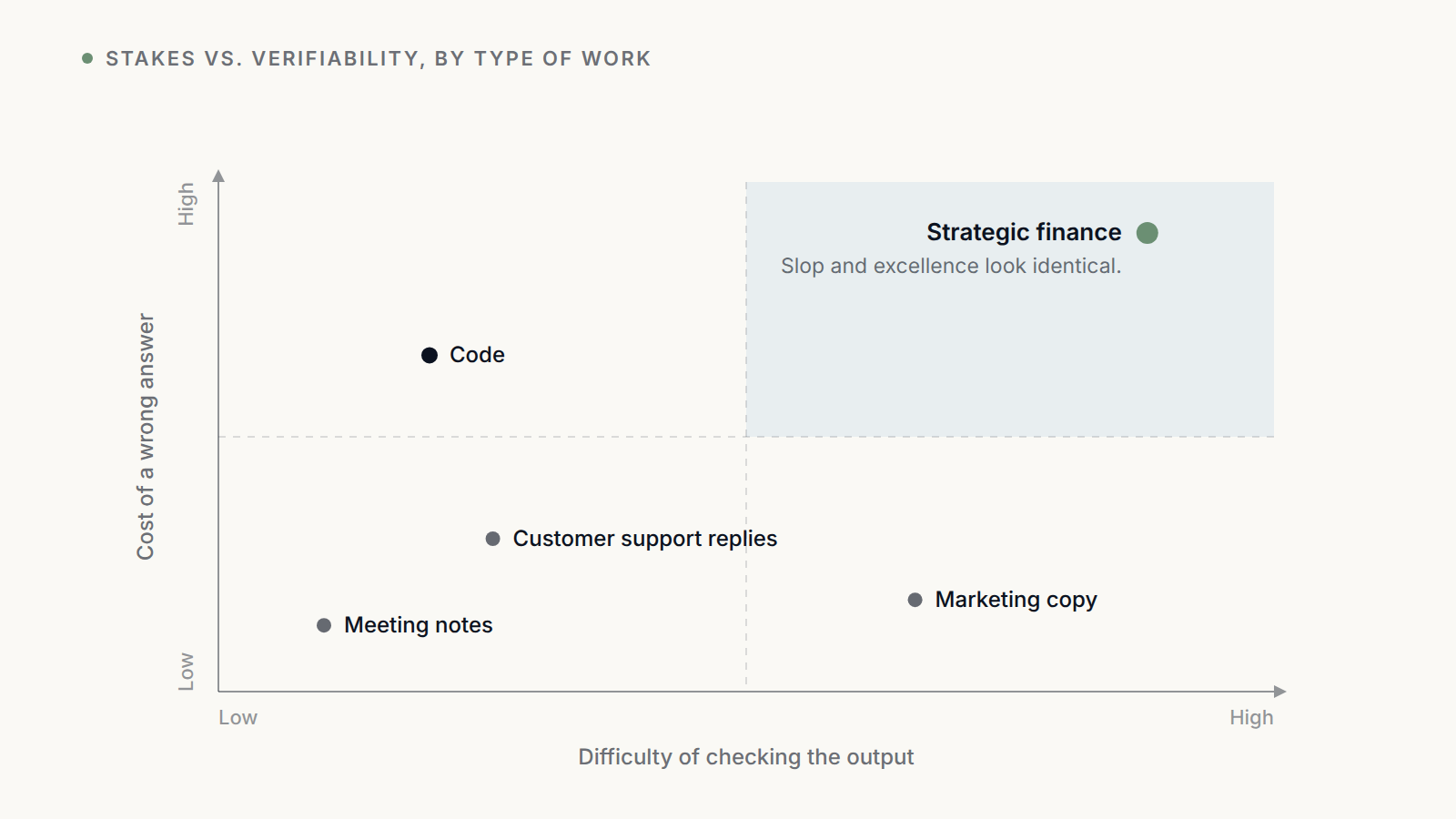
Building AI for strategic finance therefore means obsessing over traceability and the correctness of every data point, designing mechanisms that reconcile each model back to your systems, and building a taste for what excellence in this work looks like.
Blocker 4: AI is scary and overwhelming
Most AI products still lead with a chatbot interface. This presents users with an infinite space of possibilities when it comes to what we can ask. On one hand, this makes AI powerful: it can reason through problems that would usually require human judgement. But this nature of current AI tools also presents a challenge. It’s extremely overwhelming to decide what direction to go in and what to focus on.
The elephant in the room is that people are scared of AI. The technology is so powerful, and what if AI takes my job? In the present situation, it seems you have two options. One choice could be to ignore the technology. There is a vision of a world in which all competitors agree not to use AI and, as a result, don’t allow their industry to be disrupted. However, the economic incentive to break this fake equilibrium is too great.
There will always be an actor who will go all in on technology and outcompete everyone else. This means that every company will, at some point, adopt AI. The question is whether your company will adopt AI early and treat it as a compounding technological advantage or whether your company will be playing catch-up with competitors.
None of this waits on a better model
Notice what the four blockers have in common: none of them is an intelligence problem. Memory, data, and trust are all setup problems, and all are solvable today. The teams that solve them first will not just do today's work faster. They will start doing the work nobody does at all right now: the decisions currently made on instinct, and the far larger set never made, because a rigorous answer has always cost too much to reach.
If any of this resonates with you, do reach out. We are building margin to address all four of these problems, and we are more than happy to share our learnings.
Originally published on LinkedIn on August 27, 2026.